Monday, April 1, 2013

Changes Around Town

So I keep saying how much the town has changed recently.  Here are some proof before and after-type pictures to prove it.


December 2011: I remember being very excited when the first barber shop opened in the area.
October 2012: Some new buildings in the process of being built behind the barber shop (still visible on the right).
March 2013: The new buildings completed!  The yellow one is a sushi and rice bowl restaurant.  There are also several barber shops and beauty parlors in the area now.
Dec. 2011: The big hospital in the center of town (notice the green medical cross on the roof) surrounded by debris.
Oct. 2012: The hospital was torn down during the summer so some of the other buildings from that neighborhood are now visible.
Dec. 2011: During high tides the coast would often get flooded, especially near the river.
Oct. 2012: A sea wall has been built and the road has been raised so I don't have to drive through large puddles so often anymore.

Feb. 2013: The Hotel Kanyo is visible in the background.  The "boat graveyard" can also be seen in the middle-distance.  The boats themselves are actually pretty far away from the water but due to the perspective here it looks like they are in the bay.
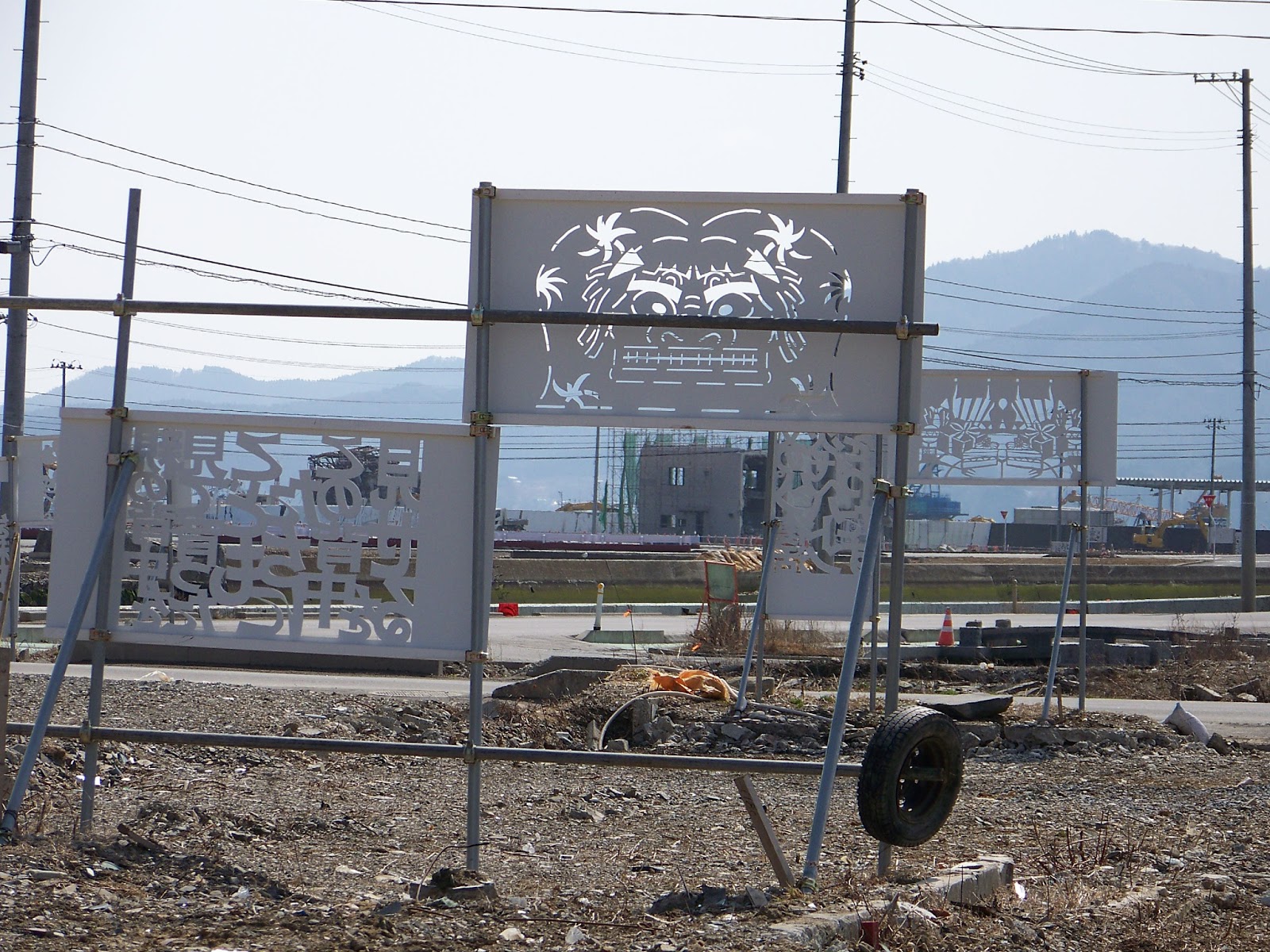
Mar. 2013: Last fall some metal sheet art pieces appeared around town.  I assume it's part of an art series of some kind(?).

Dec. 2011: Some trees that died after coming into contact with the salt water from the tsunami.  Also notice the small white car on the left that was placed on the hill by the tsunami waters.
Oct. 2012: Piles of logs from trees in the area, this pile has since disappeared.  I wonder where the wood ended up...
Oct. 2012: Piles of tree roots that were extracted from the ground after the dead trees were cut down.
Feb. 2013: A white heron looking for food by the river.
Nov. 2012: Here some building foundations and parking lots are visible.
Mar. 2013: Most of the foundations (and parking lots) have since been removed
Mar. 2013: The area looks so flat now...
Mar. 2013: Unnaturally flat...  Keep in mind that flat land is exceedingly rare in Japan (and is often used for rice fields).  That's why houses are small here - they use up less of the flat area that way.
Dec. 2011: The radio tower building (on the left).
Nov. 2012: Here the area to the right of the building is being cleared of debris.
Mar. 2013: Now the whole building is gone.  And the shopping area has a brand new bus stop (the cylindrical building a bit to the right of the center).
Mar. 2013: Here's the shopping area again; it has tons of souvenir shops, restaurants, beauty parlors, and even a couple of cake shops.
Mar. 2013: The shopping area seen from a distance.  The area looks so empty without the radio building.
Mar. 2013: Some friendly dolphins warn people to stay away from the road drainage system which still hasn't been covered with cement blocks yet.
Mar. 2013: A helpful citizen decided to cover this part of the drainage system with some random cement blocks.  They don't fit particularly well, but most cars can drive over it safely now.
Mar. 2013: The same driveway with the improvised cement blocks.  Also notice the fruit stand in the background to the left.
Dec. 2011: The fruit stand looked a bit brighter last year since it had just opened and was freshly painted.
Mar. 2013: The fruit stand now boasts two vending machines.


Feb. 2013: A local government building that was built last year.  It houses the Board of Education among other departments.

Mar. 2013: Some of the ever-present diggers.  These ones are working around what used to be the train tracks.

Dec. 2011: I was so happy when we got a laundromat down the road since it meant that we didn't have to dry our clothes inside the house anymore.  Very few Japanese homes have dryers.
Mar. 2013: Now that same laundromat has a dry-cleaners next door.  There is also a fruit stand on the right and a cafe behind.
Dec. 2011: I posted this picture last year - notice that the land still looks pretty torn up.
Mar. 2013: Now the land has been smoothed down.  I still don't know if there will be any new buildings built in this particular part of town.  It might end up just becoming a park.
Mar. 2013: Then again, with all of these building supplies maybe there will be some new structures after all.


Anyway, I haven't been able to get all of the videos to load since my internet is too slow... I'll try again later this week.

Thursday, March 14, 2013

Skiing in Japan

The school year will soon be coming to an end.  The third-years at the middle school graduated last Saturday and next Monday and Tuesday the sixth graders will have their own graduation ceremonies.  The official school-year closing ceremony will take place on Friday the 22nd; then there will be around two weeks with no scheduled classes (many students will still come to school for club activities though).  It's been busy with the graduation and the second anniversary of the earthquake and tsunami so I didn't have the time to post (even though I started writing this one back in mid-February)...

Anyway, some of our neighbors (Ryo-sensei, Principal Mori, and Tanaka-sensei) had invited Anne and me to go skiing with them sometime in February.  Mori and Ryo (whose wife, Natsu, couldn't make it that day) apparently go skiing pretty often (they have their own equipment and everything).  Tanaka-sensei, who teaches at one of my elementary schools, had only been skiing a couple of times before and somehow got roped into going along with Anne (who had gone skiing a few times) and me.  Though I've gone skiing several times before (maybe 10 times all together) I never really loved it so I hadn't been on skis for about eight or nine years.

But we weren't going solely for the sake of skiing, it was also just to take a trip, eat some good food together, and possibly stop by a hot spring on the way back.  Since there were five of us (plus two sets of ski equipment) and cars in Japan aren't nearly as large as they are in the US, we decided to take two cars.  Anne and I rode with Ryo, who enjoys practicing his English with us.  Ryo had us sit in the back seat (which in Japan is considered to be a better/more honorable place to sit than next to the driver) - though it made me feel like I was a little kid again.  It took about three hours to get from Minamisanriku to the skiing location; though we made a pit stop along the way to use the restrooms and buy some snacks.  The rest-stop had several restaurants and shops including a Royce' Chocolate shop- apparently these gourmet chocolate shops are found only in Tokyo, Sapporo, and this random rest-stop in the middle of nowhere.  According to Principal Mori and Ryo-sensei, the family who started the company had originated from the Iwadeyama area in Miyagi but had been forced to go to Hokkaido several hundred years ago (I believe after allying themselves with a group that ended up losing a war).  But after the business became successful they decided to open up a shop in their old hometown.  Royce' stores can be found in many countries in Asia, and I believe they now have a shop in New York City as well.  Anyway, their best-selling chocolate-covered potato chips are amazing (as are most sweets that combine sweet and salty flavors).

As we drove away from the coast there was suddenly a lot more snow piled up along the side of the road.  Notice the layers of snow on the left side of the road.

The mountain that we went skiing on was called 鬼首 (Onikoube which means "ogre neck") - an interesting name to be sure.  When we asked Ryo-sensei about the name he said he thought it had something to do with a story about some ogres getting their heads chopped off there but he didn't know for sure.  We rented skis and snow-pants, and bought our lift tickets.  The total cost was around ¥5900 or $61.45 with the current exchange rate (wow, that's changed a lot in the past few months).

The skiing itself was more enjoyable than I imagined it would be, though it was very windy (I actually ended up getting a bit wind-burned).  The scenery was very beautiful, so I often stopped skiing to take out my cell phone and take pictures (not the best idea but the bunny-slope we were on wasn't very crowded luckily).  It was very cold and sometimes bursts of snow would blow by like clouds so that I could barely see what was in front of me.

You can kind of see other mountains in the background through the snow.
 
I know I keep saying this but... mountains in Japan are so steep!
We only skied for a couple of hours at most before we decided to stop and grab some lunch.  We went to a ramen shop called Fukinotora near the Onikouge Ski Area.  The shopkeeper remembered Principal Mori from the last time he had visited (he's a very memorable guy) so she was very nice to us and even had us sample a "local specialty."

The conversation (which was mostly in English) went something like this:

Mori: Here, try this local meat, it's very good.
(At this point I was thinking that the dish sounded kind of suspicious but also smelled great)  
me: OK, thank you.
[I eat some]
Mori: So I guess you'd call this "deer meat" right?
me: ....

We also had some appetizers and a big bowl of vegetable and meat ramen each (for only ¥550!).

And, my conclusion after eating venison for the first time is as follows:

People should eat deer more often.  

As we started driving back towards the coast we saw a legendary machine... a Snowplow!  This was only the second time that I've seen one in Miyagi.

On the way back we stopped by a hotel to use their hot spring   The hotel owner knew the principal too and so he let us in without a problem (he also spoke very good English).  The hotel's hot spring water was actually piped in from its source to some indoor bath areas.

Unfortunately I wasn't able to get all the way into the hot tub since my feet are too sensitive to heat.  So, I must have been quite a sight as I hung over the side of the tub and dipped my arms in...  It was annoying since I had hoped that I'd be able to warm up my feet sufficiently in the shower before getting in the tub (in Japan baths are for warming up, not for getting clean - you take a shower in a separate area before entering the tub and thus prevent the tub from getting dirty.)  But unfortunately my plan failed - after attempting to enter the tub my feet went numb after about five seconds so I decided that I should probably not keep them in.

Anyway, if you ever get the chance to go to Japan in the winter then I'd recommend skiing and a dip in a hot spring for a nice day trip.

Finally, here is a picture of a Chocolate-banana waffle:

Notice the diagram of the sweet on the bottom left of the package.  The banana, chocolate cream, whipped cream, and chocolate chips are wrapped in a waffle.
The pink text reads:
"Sweets+ Quality for senses.  Happiness for hearts."
... if they just remembered some articles or pronouns it would be a lot better!  Something like, "Quality for the senses.  Happiness for our hearts."  ... could at least be considered 'poetic,' right?

Anyway, once school's out I won't have any excuses, so look forward to it!

Tuesday, February 26, 2013

Banquet food and Seaweed

Last week I went to a dinner party/banquet at a local restaurant 竜巳や (Tatsumiya - a family name) with the teachers from Hashi Middle School.  A guest lecturer had visited during the day and so the teachers were taking her out afterward.  They kindly invited me even though I wasn't working at Hashi that day.  So, for the modest price of ¥2500 (about $27 today) I was able to sample a variety of specialty foods from my area (in other words a lot of seafood).

The first course consisted of a dish of seafood (top), a pickled vegetable salad topped with crab meat (left), and a fresh veggie salad with a citrus dressing (bottom right).

The seafood in the first course included (from left to right) - a large shrimp, white tuna sashimi (uncooked), a small piece of regular 真蛸 (madako - octopus), and a piece of a rarer white octopus wrapped in green 若布 (wakame - a type of seaweed).

The second course was all about fried food - to the right of the basket (next to the lemon slice) was a vegetable 春巻き (harumaki - spring roll) sliced diagonally in half, a long piece of tempura (fried) shrimp, and two pieces of fried chicken (behind the shrimp and to the left).

There's not much else to say about the second course except to point out that in general Japanese people eat more fried food than you'd expect.  Then again if someone had asked me a few years ago what I thought people ate in Japan I would have said sushi (as in maki rolls, not real sushi) and rice.  But in reality sushi in Japan is similar to a fancy steak dinner in America - you have it but usually not very often.  I was right about the rice though.

The final course consisted of a bowl of miso soup and a plate of real sushi (with the rice located below the seafood).

Let me try to identify the fish for you (clockwise from the top): the reddish one is 鮪 (maguro - tuna), the white one is probably squid, next is crab meat, then a clump of pickled ginger, the dijon mustard-colored one is 海胆 (uni - sea urchin), at 8 o'clock is sea bass, next looks like shrimp, and in the middle... I have no idea - it was good though!  My favorite was probably the sea urchin though, it has an interesting flavor and a smooth texture.

As for drinks, we all started out with green tea as we were waiting for the food and I also ordered a cola (since it had been a while) and later on a Calpis (a sweet Japanese soft-drink).

For the rest of this post I'd like to show you my adventure cooking some seaweed that the teachers from Michiue Elementary School gave me.  The teachers attempted to give me about four times more than they actually did but I finally ended up with a five foot long wakame plant and some clumps of a kind of brown curly seaweed that I still haven't been able to find the name of.

 Here I'm attempting to show the length of the wakame.

 Here I'm cutting off the wilted pieces of the wakame (to the right) and cutting the rest into strips (upper left).


 After washing the cut seaweed, here it is up close before going into the pot.

 In this picture I'm about to drop it in the boiling water.

 A few seconds later it all turned きれいな緑 "beautiful green" just as the teachers had promised it would!

 
 I sprinkled on some ginger and also garlic powder (the latter is decidedly un-Japanese of me) and it was delicious on top of some rice.

In conclusion, give seaweed a chance!  It's delicious and also very good for you.  I used to be afraid to try new foods (I didn't even try cream cheese until I was in the 6th grade since I thought it looked weird) but I can honestly say that I like most of the new foods I try.

Tuesday, February 12, 2013

Cat's Cradle and a Nuclear Test

So yeah, there was an earthquake around noon today which in itself is no big deal.  It was a bit different from the usual one in that it was very short and abrupt and you couldn't hear it coming at all.  That's one thing I've noticed about earthquakes in the movies; the characters seem to notice furniture shaking or liquids moving in glasses first when really most of the time you notice the sound first - it's similar to the sound of a truck going by your house.  It's much rarer for things to start shaking without warning and it usually means that the earthquake's epicenter is very close...  Or apparently it could also mean that a nearby country has performed an underground nuclear test...  Yikes, I can't believe that we felt it even though we're so far away from North Korea!  Though luckily the tremor lasted less than a second.  The teachers at my school thought it seemed like a strange earthquake and so they turned on the TV to check the information about it (usually they only turn on the TV to check the magnitude and to see if there are any warnings and whatnot if it's a pretty big or long-lasting one).  On TV we saw a map of North Korea with a red X marking the calculated epicenter and at first I was like, "Wow, an earthquake in North Korea is pretty rare!" - hey, I never said that I was smart - but I saw the story on BBC news a short time after that.

But anyway, what I really wanted to talk about for this post is Cat's Cradle (well I guess technically "string figures") though I always call those kinds of string figures "Cat's Cradle" even if I'm not playing the actual game with someone else.  I've noticed that in Japan Cat's Cradle seems to be played equally amongst girls and boys (while back in the US it's considered more of a girl activity - though technically my dad's the one who taught me how to play - he grew up with three sisters).

The fifth graders at my various elementary schools are wrapping up the "What's this?" chapter in their textbooks so I thought I should give them some practice with that and also teach them the very important phrase, "I don't know."  So I decided to bring in a string and show them some Cat's Cradle patterns; basically I would show them a pattern and say, "What's this in English?" and they would try to answer with, "It's a ~." or "I don't know."

I started with the cup and saucer and at first the students answered, "杯 (sakazuki)" which means "sake cup" but when I asked for the word in English a bunch of them did say "cup" since they learned that word recently.  The cup-and-saucer can be transformed into the Eiffel Tower by holding an end of the string with your teeth.  When I asked the class about that they said, "Tokyo Tower!"  I told them that in the US we call it the Eiffel Tower and also had them guess which country that structure is in.

Next I showed them the witches' broom but none of the students knew how to say "broom" in English so I had them practice, "I don't know!"  In Japanese it's called "箒 (houki)".  When I was little my dad showed me that if you carefully remove your fingers from the bristle-end of the witches' broom you're left with four loops.  Next you tell a friend to "Pick a banana," and when your friend pulls one of the loops the whole thing comes apart so you say, "You ate them all!"  The elementary kids had never heard of this trick so I had a fun time showing it to them and saying the punchline in both English and Japanese, "全部食べましたよ!(zenbu tabemashita yo)." 

Finally I showed the kids the most complicated pattern that I know.  First I did the cat's whiskers (which I found out later is called "蝶 (chou)" or "butterfly" in Japanese).  The kids know the word for cat though so most of them figured out the US-Cat's Cradle equivalent word for it when I put the "whiskers" up to my face.  Next I showed them Jacob's Ladder which many students though was a bridge (they even said it in English).  It's called" 橋 (hashi)" or "bridge" in Japanese.  Though it is also another version of the Tokyo Tower if you hold it vertically and pinch your top index finger and thumb together.  I had to draw a picture of a ladder to explain what it was in English and the Japanese word for "ladder" is "梯 (hashigo)" which makes me think that maybe it was a pattern that came from Japan and got mistranslated in English (I mean, I always thought that it looked more like a bridge than a ladder anyway).

After my classes were over for the day I was sitting in the teacher's room studying some Japanese.  A first grader was sitting near me even though class was in session since she had said earlier that she wasn't feeling well (though I think she just wanted to sit in the warmth for a while).  She seemed a bit bored so I took out my Cat's Cradle string and showed her some moves.  She didn't know how to do any of the patterns so I taught her the cup-and-saucer.  One of the other teachers saw us playing and gave me a real Cat's Cradle string (a seamless one which makes it much easier).  Then the secretary came over and showed us some really awesome moves - it was like she could do the Cat's Cradle game all by herself!  In the end I think the first grader had a fun time though I found out later that I had taught her the non-Japanese way of setting up her string (using her index fingers) - apparently most Japanese people use their middle fingers instead - whoops!
That's all for now, hopefully I'll post again soon!

Thursday, January 31, 2013

What struck me about America...

I'd heard of reverse culture shock before returning to America for my vacation last month but I still found it strange...  I first noticed it even before I arrived home when I was at the San Francisco airport going through customs before getting on my flight to Boston.  As I was waiting for my luggage and looking around the room I could've sworn that I recognized several of the other people standing around.

My thoughts went something like this:
Hey, is that Stephanie from college over there?  I haven't seen her in ages!  What are the chances that she'd be in the same airport at the same time?  [upon closer inspection]  Wait, that's not her.  Though that woman is the same height and has the same blonde hair...  But wait, that man over there has to be Kevin that I met during that college campus tour several years ago, right?  I met him in California after all, maybe he lives around here?  [upon closer inspection]   No, that's not him.  Though that man is the same height and has similar glasses...
Basically my facial recognition skills for non-Japanese faces had apparently degraded in the months that I'd lived in Japan...

I also found that many everyday things and events in the US had become surprising to me...

Once I arrived in Boston my mom and brother picked me up from the airport (luckily I recognized them).  Even though it was around midnight I was wide awake due to the time difference and blabbed about who-knows-what as we headed back to my mom's condo.  As we were driving I couldn't get over how wide the roads were, and as we got onto the Mass Pike (Massachusetts Turnpike) I was a little freaked out by how many lanes there were (I mean cars could pass us on both sides!).  Don't get me wrong, there are multi-lane highways in Japan, there just aren't any where I live.  The closest real highway to Minamisanriku is called the Sanriku Expressway and it is usually one lane wide (though there are two when you approach exits and merging lanes).  Cars can also go much faster on US highways, oftentimes the speed limit is 65 mph (~105 km/h) in MA but on the Sanriku Expressway the speed limit is about 43 mph (70 km/h).  Anyway it wasn't until the next day that I noticed how big the cars are in the US; even the smallest ones would get a white license plate in Japan.

The roads are so wide!

When I got to my mom's place not only did it seem very large but there were tons of places where one could sit down.  There was a dining room table with four chairs, two tall bar-stool-type chairs by the kitchen counter, and a couch and armchair in the living room (and that was just the first floor)!  In fact, overall things in America seemed way more comfortable and convenient than they are in Japan.
I noticed that:

- buildings were warm inside (even places like closets and hallways)!
- windows were double-paned and thus fog-proof!
- kitchens had ovens and dishwashers!
- not only were there washing machines, there were also dryers!
- there were no squat-type toilets!
- every sink had a hot water supply!
- roads were plowed!

So much snow but the roads are kept clear!

In fact, everything was so convenient that it made me a bit angry.  I think that it was partially because all of the above things on the list are so difficult in Japan but mostly I was angry because no one in the US seems to appreciate all the things that make their lives so easy!

Anyway, on a more positive note I got many hugs from my family members which I wasn't really used to after all the bowing that I do in Japan.  I was also happy that I finally felt literate again since I could read all of the signs, warning labels, and even advertisements again.  In addition, everything seemed very close-by; there were two movie theaters less than 20 minutes away!

I had created a list of food to eat before arriving in the US and I managed to eat at least a piece of the following:

sourdough bread
wheat bread
balogna
ham
a piece of a full-sized cake (not roll cake!)
a piece of pie
coffee ice cream
peppermint bark
several bagels
several muffins
gingerbread
croissant
Cape Cod potato chips
Chips Ahoy! cookies
Smartfood popcorn
baked Cheetos
Regina pizza
Panera panini
Trader Joe's chocolate
Mom's pot roast
Mom's macaroni and cheese

My brother, Mikey, and I drove up to Maine to visit some friends and I couldn't get over how flat everything seemed.  Massachusetts has its share of hills (left over from glaciers and whatnot during the last ice age) but it's nothing compared to most of Japan.  The hills and mountains in Japan are so steep that they cut into the horizon wherever you look but in the US you can see the entire sky.

I took several pictures of sunsets while I was back home...

Traveling with my brother was fun.  The town we went to was about five hours away but that didn't seem too bad when I considered that decent groceries are an hour away from Minamisanriku.  We spent the night in Maine and overnight we got about 16 inches (~40 cm) of snow.  Luckily it was very light and fluffy so we were able to dig out the car without much difficulty.

Our friend's Bernese mountain dog sitting in the snow

There were only a few other things I noticed in the US after I had been there for a few days:

- lack of surgical masks - people are obsessed with them in Japan and will wear them to prevent illness - which does not work just so you know
- perfect teeth - wow, you can tell that it's an obsession in the US
- cheap prices - I mostly noticed at the movies and at the gas pump - I created the following table using today's information:

Of course there were some changes around my hometown as well but to be honest I think there were more changes to Minamisanriku in the three weeks that I was gone.  I'll have to take pictures around town again to show you what I mean...